

Let’s face it: golf is hard enough. The last thing you need is your own gear working against you. We obsess over driver shafts and putting grips but often tolerate a golf bag that causes daily frustration. It’s the silent partner that can either elevate your experience or add hidden strokes through sheer annoyance. From the walker battling a sore shoulder to the traveler sweating over airline baggage handlers, the wrong bag is a constant source of small, accumulating pains. But what if your golf bag could actually solve problems instead of creating them? Let’s diagnose the top five universal golf bag pains and talk about real solutions.
Pain Point #1: The “Heavy Burden” Shoulder Ache

The Symptom: After nine holes, one shoulder is noticeably lower than the other. A dull ache sets in between your shoulder blades, and the simple act of lifting the bag for another shot becomes a conscious effort. This is the classic hallmark of an unbalanced, poorly padded, or just plain heavy bag.
The Root Cause: Many golf bags are designed with a single, flimsy strap or poorly contoured dual straps that don’t distribute weight evenly. Combined with excessive weight from the bag’s own construction, every hill feels steeper.
The Solution: Seek out true ergonomic dual shoulder straps that are wide and padded. The goal is to transform a carrier into a comfortable, backpack-like experience. More fundamentally, consider a lightweight design. Every kilogram saved on the bag itself is a kilogram more energy you have for your swing on the back nine. A bag built around lightweight comfort doesn’t mean sacrificing durability; it means smarter material choices and design priorities focused on the walker.
Pain Point #2: The Wobbly, Unreliable Stand
The Symptom: You go to place your bag on a gentle slope, and it slowly topples over, scattering your clubs onto the wet grass. Or worse, the stand legs stick, fail to deploy, or collapse unexpectedly. This isn’t just annoying; it’s damaging to your clubs and disrupts your focus.
The Root Cause: A flimsy, two-legged stand system or one made with weak springs and poor pivot points. Stability on uneven ground is an engineering challenge many cheap golf bags fail.
The Solution: Look for a stable tripod stand system or a reinforced, wide-based stand. A triangular tripod structure offers superior balance on slopes, rough terrain, and perfectly flat surfaces alike. It should deploy with a confident click and retract seamlessly. This feature is non-negotiable for any serious walking golfer and transforms your stand bag from a tentative leaner into a steadfast caddie.
Pain Point #3: The Travel Terror

The Symptom: That heart-dropping moment when you see the baggage cart drive past the terminal window, with your soft-sided golf bag tossed under a pile of suitcases. The anxiety of the entire flight centered on whether your prized driver head will be snapped off.
The Root Cause: Using a standard bag or a soft-shell travel cover for airline travel. They offer minimal protection against the brutal realities of checked luggage handling.
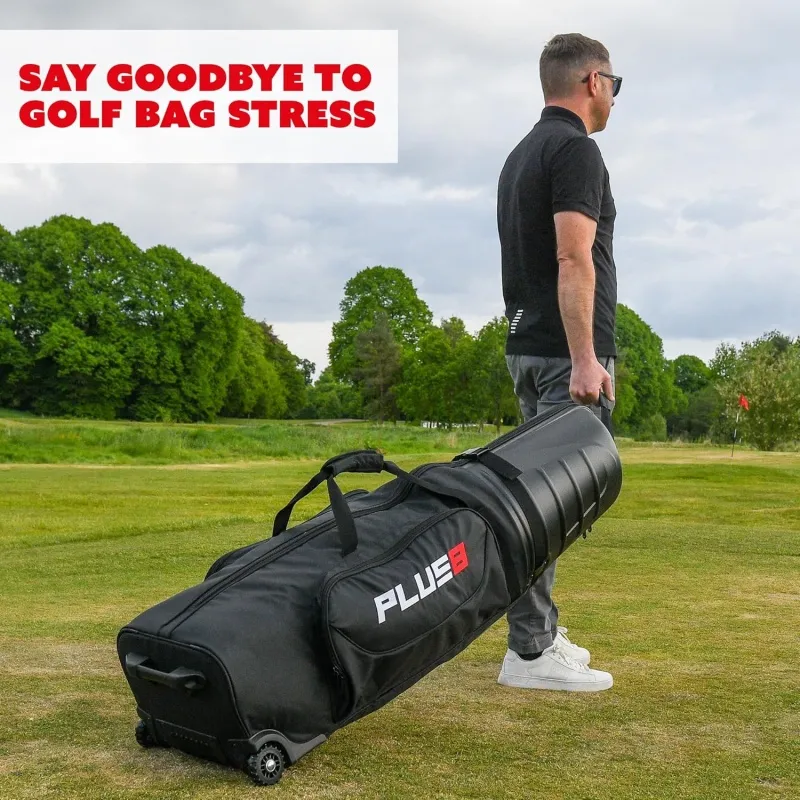
The Solution: For air travel, you need a dedicated armored guard. A hard-case golf travel bag is the only answer for true peace of mind. Look for features like hard-shell protection constructed from impact-resistant ABS materials and smooth-rolling wheels for easy airport navigation. The best travel bags, like our Plus 8 Hard Case Golf Travel Bag, are built like tactical gear, with 1680D nylon fabric and reinforced construction specifically to be an airline luggage protector for clubs & gear. It’s an investment that protects a much larger investment.
Pain Point #4: The Black Hole of Chaos (A.K.A. The Main Compartment)
The Symptom: The dreaded club tangle. You try to pull out your 7-iron and bring three other grips with it, creating a frustrating minute of untangling. Or, your shorter wedges constantly disappear into the abyss, requiring you to upend the bag to find them.
The Root Cause: A single, cavernous compartment or a divider system that’s poorly designed with too few, too-small openings. It doesn’t properly separate the grips.
The Solution: Intelligent organization. A 5-way top divider or a spacious club divider system is key. The openings need to be large enough to easily insert and remove clubs but structured enough to keep grips apart. For some, a retractable design that lets you lock the club cover at different heights can be a game-changer, preventing shorter clubs from sinking and longer clubs from shifting. The goal is immediate visual and physical access to every club.
Pain Point #5: The Awkward, Cumbersome Haul
The Symptom: Navigating from the parking lot to the clubhouse, or from your apartment to the car, feels like a full workout. The bag bangs against your legs, the handle digs into your palm, and tight spaces become an obstacle course.
The Root Cause: A bag that only offers one difficult carrying option. Many bags are awkward to hand-carry and equally awkward to shoulder-carry, excelling at neither.
The Solution: Versatility in mobility. For everyday transport, dual carrying methods—like a padded shoulder strap and a rubber non-slip handle—give you options based on the distance. For ultimate maneuverability in tight spaces like elevators, garages, or crowded pro shops, a bag with 360° universal wheels is revolutionary. It rolls smoothly in any direction, turning a bulky carry into a graceful glide. It’s a feature that redefines convenience from the moment you leave your house.
FAQ: Quick Answers to Common Golf Bag Queries

Q: I walk most rounds. What’s the maximum weight I should look for in a stand bag?
A: For a comfortable walking experience, aim for a lightweight bag under 5 pounds (approx. 2.3 kg). The lighter, the better, as long as it doesn’t sacrifice crucial stability and durability. Every ounce counts over 4+ miles.
Q: Is a hard-case travel bag really necessary, or is a soft padded one enough?
A: For frequent flyers or anyone with expensive clubs, a hard case is strongly recommended. Soft cases protect against scuffs and light rain, but only a rigid hard-shell design provides reliable protection against the crushing forces and impacts of airline cargo handling. It’s the best insurance policy you can buy for your clubs.
Q: My current bag’s stand legs are wobbly. Is this fixable?
A: Often, wobble is due to worn pivots or a loose internal mechanism. While temporary fixes with tape or washers exist, they are rarely reliable. If the bag is under warranty, contact the manufacturer. Otherwise, this is usually a sign of fundamental wear. Investing in a bag with a renowned, stable stand system from the start is a more permanent solution.
The Antidote to Annoyance: Choosing a Bag That Works With You
The common thread through all these pains is a golf bag that is passive or, worse, antagonistic to your game. The solution is a bag designed with active problem-solving in mind. It means looking for golf bags for sale that specifically advertise solutions: lightweight materials for fatigue, stable stands for reliability, intelligent dividers for organization, and versatile carrying systems for effortless transport.
Consider the approach of the upright golf bag. It tackles multiple pains head-on with engineered features. Its retractable design with lockable height directly solves the club-shifting black hole problem (Pain Point #4). The dual carrying methods and 360° universal wheels elegantly address the cumbersome haul (Pain Point #5), making transit effortlessly adaptable. The inclusion of a stable stand and water-resistant materials preempts other common frustrations. It’s a bag that feels like it was designed by someone who has actually carried clubs for 18 holes and thought, “There has to be a better way.”
Stop enduring a problematic partner. Your golf bag should be the one piece of equipment you never have to think about. Choose one that eliminates the pains, and you’re free to focus on the only thing that should be difficult on the course: your score.